The best STEM toy matches what your child is already curious about. Children who love dinosaurs tend to enjoy dig kits, animal lovers enjoy synthetic dissection kits, children who take things apart enjoy circuit sets, and those who like pets or gadgets enjoy robots they can control or program. Choose by interest first and age label second, and plan to do the first session together, because that is what turns a box into a hobby.
Want a science or robot gift for Christmas? See STEM and learning Christmas gifts, or browse the full Christmas Gift Guide UAE 2026.
Science kits can be among the most satisfying gifts or among the most quickly forgotten. This guide helps you pick one that gets used.
Contents
- Dig and excavation kits
- Synthetic dissection kits
- Circuit and physics sets
- Robot toys
- For preschoolers
- How to make a kit last
- Common questions
Dig and excavation kits
Children chip away at a block to uncover what's hidden inside. It's patient, hands-on work, and the reveal is the reward. The Discovery Mindblown Giant Dino Egg Excavation Kit includes digging tools and ten glow-in-the-dark dinosaur replicas.
Tip: digging is dusty. Do it on a tray, outdoors or on newspaper, and dampen the block slightly if the instructions allow it.
Synthetic dissection kits
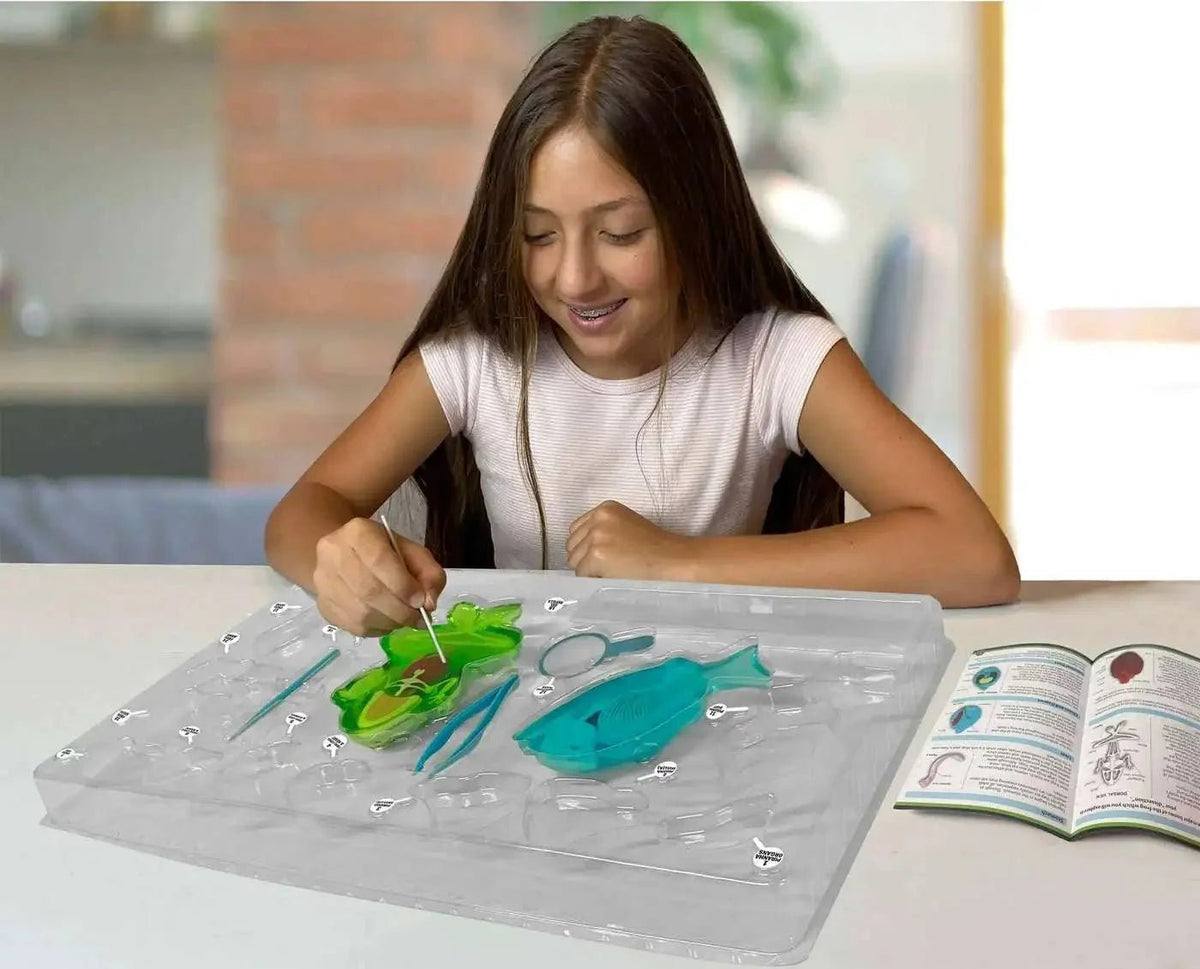
These let children explore anatomy with soft, realistic synthetic models and child-safe tools, with no real animals involved. The Dissect It Piranha and Frog kit covers two animals, and the Dissect It Frog Lab is a smaller place to start.
They suit children who ask "what's inside?" and pair well with a children's anatomy book or a nature documentary.
Circuit and physics sets
Circuit kits show how electricity flows by letting children build something that visibly works. The Discovery Mindblown Particle Analyzer and the Action Circuitry Floating Ball Experiment Set both have children build a circuit that makes a ball float in mid-air.
These suit slightly older children who can follow step-by-step instructions, and they're a natural next step for anyone who enjoys LEGO Technic-style building.
Robot toys
Robot toys range from simple movement to basic programming.
- Lifelike robots: the Robo Alive Raptor moves, roars and bites. It's more pet than project, but a good way in for dinosaur fans.
- Gesture-controlled: the Silverlit Robo Dash dog follows hand gestures and can also be steered manually.
- Programmable: the Xtreme Bots Patrol Bot can be programmed with a sequence of up to 50 actions from its infrared remote, which introduces the idea of coding as a list of instructions.
- Climbing: the Bionic Wall-Climbing Gecko climbs smooth vertical surfaces, a fun talking point about how suction works.
See more in Robotic Toys and our guide to remote control toys.
For preschoolers
Under-fives get more from cause-and-effect than from kits with small parts. The LeapFrog My First STEAM Tablet introduces science, technology, engineering, art and maths through guided activities, with no small pieces to lose.
How to make a kit last
- Do the first session together, then step back.
- Ask questions instead of giving answers: "What do you think will happen if...?"
- Keep a notebook for drawings and results. It makes the experiment feel real.
- Store all the pieces in one labelled box so the kit can be repeated.
Browse the full range in Science and Exploration Sets.
Common questions
What is a good first science kit?
A dig kit is an easy first choice because the steps are simple and the reward is clear. Children who love animals often enjoy a synthetic dissection kit, and those who like building tend to enjoy circuit sets.
Are dissection kits real?
The kits in this guide use synthetic models with a soft, realistic texture. No real animals are used.
At what age can children use robot toys?
Simple lifelike and remote-controlled robots suit many children from around five or six, while programmable robots suit children who can follow multi-step instructions. Always check the age on the box.
How do I stop a science kit being used once and forgotten?
Match the kit to an existing interest, do the first session together, keep a simple results notebook, and store all the parts in one box so the experiments can be repeated or extended.
Keep reading
- Magnetic Tiles and Magnetic Blocks: A Parent's Buying Guide by Age, Piece Count and Safety
- How Many Puzzle Pieces Should My Child Do? A Jigsaw Puzzle Guide by Age
- Remote Control Toys for Kids: How to Choose the Right RC Car, Creature or Drone
- Best Educational Toys in UAE: An Age-by-Age Guide for Parents
- After-School Arts and Crafts: A UAE Parent's Guide to Calm, Creative Afternoons